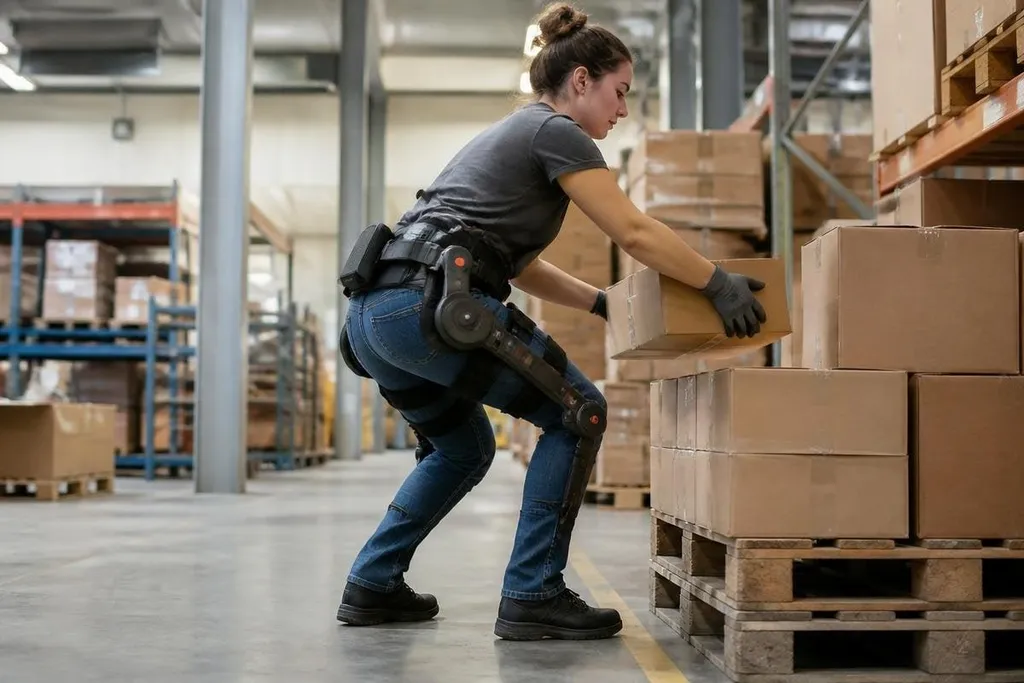
An exoskeleton can move with a person and add torque at the hips, knees, shoulders, or hands. That can reduce the force a worker’s muscles must produce, but it won’t make every task easier or make a person stronger in every sense.
For someone comparing wearable robots for lifting, assembly, or rehabilitation, the useful question is narrower: which joint gets help, during which motion, and at what cost to movement?
- Powered joints add torque: motors or other actuators help produce movement around a joint.
- Passive frames store energy: springs can return force during a repeated motion without a motor.
- Fit controls the result: a frame that slips or presses on the body can create new strain.
Where the extra force comes from
A powered exoskeleton uses actuators, such as electric motors, to add torque. Torque is turning force. At a worker’s knee, that support can help with squatting, standing, or climbing when the system detects the start of a movement.
The frame must send that force into the right part of the body. A rigid link near the thigh, a joint beside the knee, and a support around the lower leg form a load path.
If the robot’s joint and the person’s joint do not stay lined up, the device can resist the motion it was meant to help.
Passive exoskeletons work through springs, elastic parts, or counterbalance systems. They don’t need a motor for every movement, which can reduce weight and battery needs. Their help is limited to the motion built into the frame, so they fit repeated jobs better than tasks that change from one moment to the next.
Stronger for one motion, not every motion
An exoskeleton may reduce muscle effort during a lift while adding weight during walking. The person still carries the frame, battery, control hardware, and any force that passes through the device.
That trade matters on a factory floor. A back-support frame may help during repeated forward bends, yet become awkward when a worker turns, reaches sideways, or moves around another person. A shoulder system may hold an arm up for overhead work, but it can limit quick hand movements if the frame resists rotation.
Control software also shapes the result. The system needs to detect motion through joint sensors, force sensors, or changes in motor load, then apply support at the right time. A late push can feel like resistance. A poorly tuned motor can make a normal step feel stiff.
The person remains responsible for balance, object control, and safe movement. Extra force at one joint can move stress to another joint, especially when the load, posture, or floor changes.
The workplace test is harder than the demo
A short demonstration can show an exoskeleton lifting a box or holding an arm overhead. It doesn’t answer how the device behaves after hours of wear, across different body sizes, or when the worker must leave the task area quickly.
Battery life, charging time, frame weight, cleaning, and adjustment all affect daily use. So do emergency release points and access to controls. A device that helps during one lift but takes too long to remove may slow the wider job.
An exoskeleton trial should record the load, task, wear time, and strain measured on the worker. Reports from Robot 24 can place those details beside the maker’s claim, so the result has a workplace setting rather than a lab number alone. The harder test comes next: whether the machine can respond to the person wearing it.
The open limit is human-machine fit. A robot can add force at a joint, but it cannot know every posture, surface, object, or pain signal without good sensing and careful control.
A practical buying check
Before you compare a wearable robot, check these points:
- Name the motion: write down the exact task, such as repeated squats or overhead holding.
- Check the load path: see where the frame sends force into the body and where pressure touches skin.
- Measure the added weight: include the battery, controller, cables, and protective parts.
- Test movement changes: turn, walk, reach sideways, kneel, and step away from the work area.
- Check removal time: time how long it takes to release the device during a normal shift.
- Ask for evidence: request results from the same task, user group, and work setting you care about.
I'd skip any exoskeleton sold as a general strength upgrade without a defined task, measured support, and a clear account of its limits.
The useful future test is simple: can the worker finish the target task with less strain, keep normal movement, and remove the frame without slowing the job?